 silicone@silic0ne.com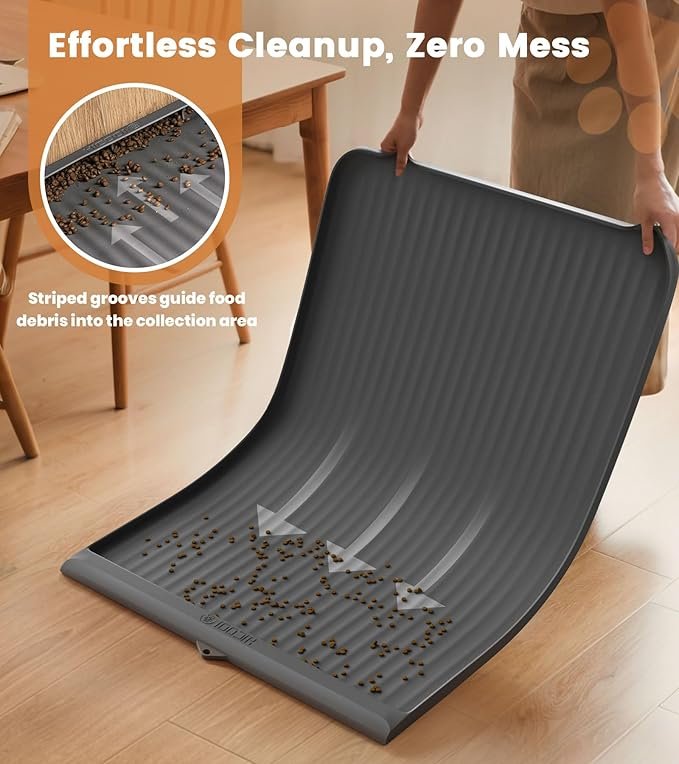
Every morning, it looked like a crime scene.
Water splashed across the kitchen floor like a tiny tsunami had hit. Kibble pieces scattered in a three-foot radius, rolling under the refrigerator, hiding beneath the stove, crunching underfoot when I walked to the coffee maker in bare feet. And the slobber—the glorious, gelatinous, somehow everywhere slobber.
I love my dog. I do. He is a 70-pound Labrador mix with the soul of a poet and the table manners of a construction worker. But every meal time was a disaster. I tried towels (they slid). I tried cheap plastic mats (they curled at the edges). I tried moving his bowls to the garage (my husband vetoed that one).
I was spending more time cleaning up after his meals than I spent cooking my own.
Then, a friend who runs a dog daycare looked at my worn-out kitchen floor and said four words that changed everything: “You need a real mat.”
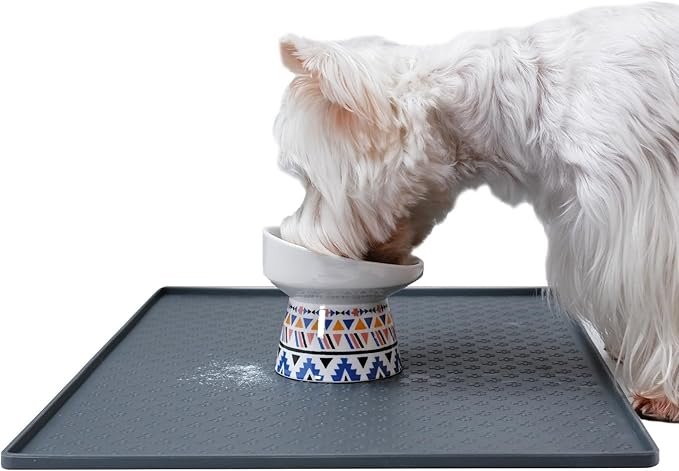
She introduced me to the Dog Food Mat 36″x24″ – a waterproof, non-slip, mess-containment system disguised as a simple grey rectangle. It looked unassuming. It looked almost too simple. But the first time I put it down, filled the bowls, and watched my dog eat, I understood.
This wasn’t a mat. It was a force field.
Part I: Size Matters – Why 36″ x 24″ is the Goldilocks Dimension

Let’s start with the numbers, because in the world of pet feeding mats, size is the single most important decision you will make.
A small mat—say, 18″ x 12″—is cute. It fits neatly next to the refrigerator. It looks tidy. But it is also functionally useless. A dog does not eat in a tidy little circle. A dog eats with his whole body. He steps forward. He steps back. He shakes his head. He drops a mouthful of kibble, takes a step to the right to pick it up, and drops more.
The 36″ x 24″ dimension (that is three feet long by two feet wide) is the sweet spot for medium to large dogs. Here is what that space actually accommodates:
- Two full-sized bowls (one for food, one for water) with comfortable spacing between them.
- The dog’s front paws while he eats, keeping muddy feet off your floor.
- The “splash zone” – the area where water flies when your dog drinks and then lifts his head.
- The “scatter zone” – the radius where kibble rolls when your dog uses his nose to push the bowl around.
For smaller dogs? This mat is a palace. For giant breeds? It contains most—though not all—of the mess. (Let’s be honest, a Great Dane drinking water is a force of nature that no mat can fully contain.)
The mat covers approximately 6 square feet of floor space. That is enough to protect the high-traffic feeding area without taking over your entire kitchen. It fits under a standard kitchen table. It tucks neatly against a wall. And it provides a clear, defined “dining room” for your pet—a psychological boundary that actually helps some dogs eat more neatly.
Part II: The Raised Edge – The 0.75-Inch Wall That Saves Your Floor

Here is the engineering feature that separates a real pet feeding mat from a glorified placemat: the raised edge.
At 0.75 inches high (three-quarters of an inch), the perimeter of this mat acts like a tiny retaining wall. It is not tall enough to trip a dog or catch a paw. But it is tall enough to stop liquid in its tracks.
What the raised edge contains:
- Water spills: When your dog drinks and pulls his head back, water drips from his jowls. On a flat mat, that water runs to the edge and off onto the floor. On the Dog Food Mat, it hits the raised edge and pools inside the mat.
- Kibble scatter: A rogue piece of food that rolls away from the bowl hits the raised edge and stops. It does not travel under the refrigerator.
- Slobber and drool: For breeds that produce impressive volumes of saliva (looking at you, Mastiffs and Saint Bernards), the raised edge keeps the feeding zone’s biological material contained.
- Mud and dirt: If your dog comes in from the rain and eats immediately, the mud from his paws stays on the mat, not your hardwood.
Hardwood floor owners, listen closely. Water is the enemy of wood. A single unnoticed puddle left overnight can warp a floorboard permanently. Carpet owners face a different nightmare: water soaking into the fibers, creating mildew and stains. The raised edge on this mat is your insurance policy against expensive floor damage. It is a 0.75-inch wall of prevention.
Part III: The Diversion Grooves – A Genius Drainage System

The raised edge handles the perimeter. But what about the water that pools inside the mat? If the mat were simply a flat surface with a wall, your dog’s feeding area would become a shallow wading pool. That is where the diversion grooves come in.
Look closely at the surface of the mat. You will see a system of channels—small, strategically placed grooves—that guide spilled water toward specific collection areas. Instead of water sitting in a puddle under your dog’s water bowl (where it creates a muddy, bacteria-friendly swamp), the grooves direct the flow to the edges where it can be easily wiped up.
How the grooves help:
- They prevent pooling: Water does not accumulate directly under the bowls, which means your dog’s paws stay dry and the bowls do not slide around on a film of moisture.
- They make cleanup faster: Instead of mopping a large wet area, you simply wipe the grooves and the collection points. The mess is concentrated, not spread out.
- They trap dry debris: Kibble crumbs and dried food particles fall into the grooves, where they stay until you rinse the mat. They do not get tracked across the kitchen floor on your socks.
The system is especially effective for puppies and messy eaters – those chaotic, enthusiastic, still-learning self-control dogs who seem to wear more food than they consume. The grooves give their chaos a direction, channeling the mess into manageable zones.
Part IV: Non-Slip Grip – Keeping Bowls (and Dogs) in Place
Have you ever watched a dog push his food bowl across the floor? It is both hilarious and infuriating. He nudges it with his nose. It slides six inches. He nudges it again. It slides another six inches. By the end of the meal, the bowl is three feet from where it started, and there is a trail of kibble marking its journey.
The non-slip surface of this mat solves that problem entirely.
The material is engineered with a grippy texture that grabs the bottom of stainless steel, ceramic, and plastic bowls. No matter how enthusiastically your dog eats, the bowls stay put. This has three benefits:
- Less mess: Bowls that do not move do not scatter food.
- Less frustration: Your dog can eat without chasing his dinner across the room.
- Less noise: No more scraping sounds of metal bowls sliding on tile.
The mat also grips the floor. The bottom of the mat is designed to stay put on hardwood, tile, laminate, concrete, and even low-pile carpet. You will not find yourself kicking the mat back into place every time your dog steps off it. It stays where you put it.
Part V: Easy to Clean – Because You Have Better Things to Do

Here is the moment of truth for any pet feeding mat: the cleanup.
Some mats claim to be “easy to clean” but require you to scrub them with a brush, hose them down in the yard, or run them through a washing machine (where they emerge twisted and damaged).
The Dog Food Mat is made from food-grade silicone – the same material used in high-end kitchen bakeware and baby products. Silicone has a magical property: nothing sticks to it.
Cleaning this mat is a three-step process:
- Pick up the bowls.
- Wipe the mat with a damp cloth or sponge. (A little soapy water for sticky messes.)
- Rinse or air dry.
That is it. Dried kibble crumbs wipe away. Dried water spots disappear. Even the dreaded “wet food smear” – that greasy ring left by canned food – lifts off with minimal effort.
Because silicone is non-porous, it does not absorb odors or stains. You will never have a mat that smells like old dog food, even after months of use. You will never see a yellow stain from a turmeric-heavy diet. The mat stays looking (and smelling) fresh.
Dishwasher safe? Yes. If you want a truly deep clean, roll it up (gently) and place it on the top rack. The silicone survives the heat and the water pressure without warping or degrading.
Part VI: Hanging Holes – The Storage Detail You Did Not Know You Needed
The mat includes built-in hanging holes – small, reinforced openings near one edge. Why does this matter?
Because a wet mat left flat on a counter or floor takes forever to dry. It collects dust. It gets stepped on. It becomes one more thing cluttering your space.
With the hanging holes, you can:
- Hang the mat on a hook next to your pet’s feeding station.
- Hang it over a towel bar or shower rod to drip-dry after washing.
- Store it on a pegboard in your mudroom or utility area.
- Hang it on a suction cup hook inside a cabinet door.
Hanging allows air to circulate on both sides of the mat, drying it quickly and completely. No musty smells. No mildew. No waiting.
When you are traveling or moving the mat between rooms, the hanging holes also make it easy to carry. Loop a finger through one of the holes, and the mat folds over your hand. It is a small detail, but it transforms the mat from “awkward floppy thing” to “practical tool.”
Part VII: The Neutral Grey Aesthetic – Finally, a Pet Product That Does Not Scream “PET PRODUCT”
Let’s be honest about the state of pet product design. Most dog bowls and mats come in bright red, electric blue, neon green, or inexplicably aggressive paw-print patterns. They look like they belong at a child’s birthday party, not in a grown-up’s kitchen.
The grey color of this mat is a deliberate design choice. Grey is neutral. Grey is subtle. Grey blends in.
- On grey tile floors, the mat is nearly invisible.
- On dark hardwood, it recedes into the background.
- On light laminate, it provides gentle contrast without clashing.
- On carpet, it looks intentional, not like a plastic eyesore.
Your home decor should not have to accommodate your dog’s feeding accessories. The accessories should accommodate your home. This grey mat allows you to maintain your aesthetic while still providing your pet with a functional, high-quality feeding station.
The matte finish (non-glossy) also reduces visible wear. No shiny scratches. No distracting reflections. Just a calm, quiet surface that says, “This is where the dog eats, but we are not going to make it weird.”
Part VIII: Food-Grade Safety – Because Your Dog’s Nose and Paws Matter
Your dog spends a lot of time with his face near this mat. He sniffs it. He steps on it. He might even lie down on it after a meal. The material matters.
This mat is made from food-grade silicone – the same standard used for baby bottle nipples, baking mats, and restaurant kitchen tools.
What “food-grade” means for your dog:
- Non-toxic: No BPA, no phthalates, no lead, no cadmium.
- No chemical off-gassing: The mat does not smell like a new shower curtain or a factory floor.
- Gentle on paws: The surface is soft enough to be comfortable, textured enough to be non-slip.
- Gentle on noses: When your dog snuffles around looking for fallen kibble, his sensitive nose touches only safe, inert silicone.
Cheap vinyl or PVC mats often contain plasticizers that can leach out over time, especially when exposed to warm water or dish soap. Your dog does not need to be licking those chemicals off his paws. The silicone mat eliminates that risk entirely.
Part IX: Odor-Free and Quick-Drying – The Hygiene Factor
Wet fabric mats (towels, absorbent placemats) are bacteria factories. They trap moisture, food particles, and saliva, creating a warm, damp environment where microbes thrive. Within 24 hours, a wet fabric mat can smell sour.
Silicone does not trap moisture. It does not absorb liquids. Water beads up on the surface. Wipe it off, and the mat is dry. No standing moisture. No bacterial breeding ground.
The odor-free property is a revelation if you have ever owned a fabric mat that developed that permanent “wet dog” smell. The silicone mat never smells. Even if you forget to clean it for a few days, it will not develop a funk. A quick rinse, and it is like new.
Quick-drying also means you can wash the mat and put it back down immediately. No waiting hours for it to dry. No rotating between multiple mats. One mat, one meal, one quick wipe, and you are done.
Part X: Who Actually Needs This Mat?
The Dog Food Mat 36″x24″ is not for every dog owner. But if you answer “yes” to any of the following questions, it is for you.
- Do you have hardwood floors? (Yes → buy the mat.)
- Does your dog drink like he is trying to empty the bowl in one breath? (Yes → buy the mat.)
- Do you have a puppy who is still learning table manners? (Yes → buy the mat.)
- Do you hate stepping on dry kibble with bare feet? (Yes → buy the mat.)
- Do you currently use a towel under your dog’s bowls? (Yes → buy the mat. Throw the towel away.)
- Is your dog a senior who sometimes misses the bowl? (Yes → buy the mat.)
- Do you have multiple dogs who eat side by side? (Yes → buy the mat. Maybe two.)
- Do you simply love your dog and want to make his life (and yours) easier? (Yes → buy the mat.)
Part XI: Real-World Test – One Week with a Labrador
I tested this mat for one week with my previously mentioned 70-pound Labrador mix. Here is what happened.
Day 1: I put down the mat. He sniffed it suspiciously. I placed his bowls on top. He ate. Water splashed. Kibble scattered. Everything stayed on the mat. I wiped it clean in 30 seconds. I cried a little tear of joy.
Day 2: He got the zoomies immediately after drinking. Muddy paws on the mat, not the floor. Wiped clean.
Day 3: Wet canned food smeared on the mat. I thought, “Surely this will stain.” It did not. Wiped clean.
Day 4: I forgot to clean the mat after dinner. Left it overnight. Next morning, the dried kibble crumbs wiped off with a dry paper towel. No scrubbing.
Day 5: My toddler “helped” by pouring an entire water bowl onto the mat. The raised edges contained 95% of the water. A single towel absorbed the rest.
Day 6: I hung the mat to dry after washing. It was dry in an hour.
Day 7: I realized I had not mopped the kitchen floor in a week. The floor was clean. The mat had done its job.
Conclusion: The Mat Your Floor Has Been Begging For
The Dog Food Mat 36″x24″ is not glamorous. It will not win design awards. It will not impress your dinner guests. But it will do something far more valuable: it will make your life easier, every single day, three times a day, for years.
It protects your floors from water damage.
It saves you time on cleanup.
It keeps your dog’s feeding area hygienic and odor-free.
It looks subtle and neutral in your home.
It is safe, durable, and absurdly easy to maintain.
For less than the cost of a single vet visit, you can buy peace of mind. You can stop mopping. You can stop sweeping. You can stop that silent, simmering resentment every time your dog splashes water onto your hardwood.
Buy the mat. Put it down. Watch your dog eat. And then walk away, knowing your floor is safe.
Because a clean floor and a happy dog are not mutually exclusive. They just needed the right mat.